Sheets
Use the Sheet family for flat laminate, panel, blank, or drawing-defined flat-stock requirements.

An early-stage guide to separating material form, construction route, geometry, and sourcing inputs before choosing the correct product family.
“Carbon fiber type” can refer to a product form, laminate architecture, construction route, or surface appearance. Buyers should first define the required geometry and application, then follow the appropriate family or processing pathway.
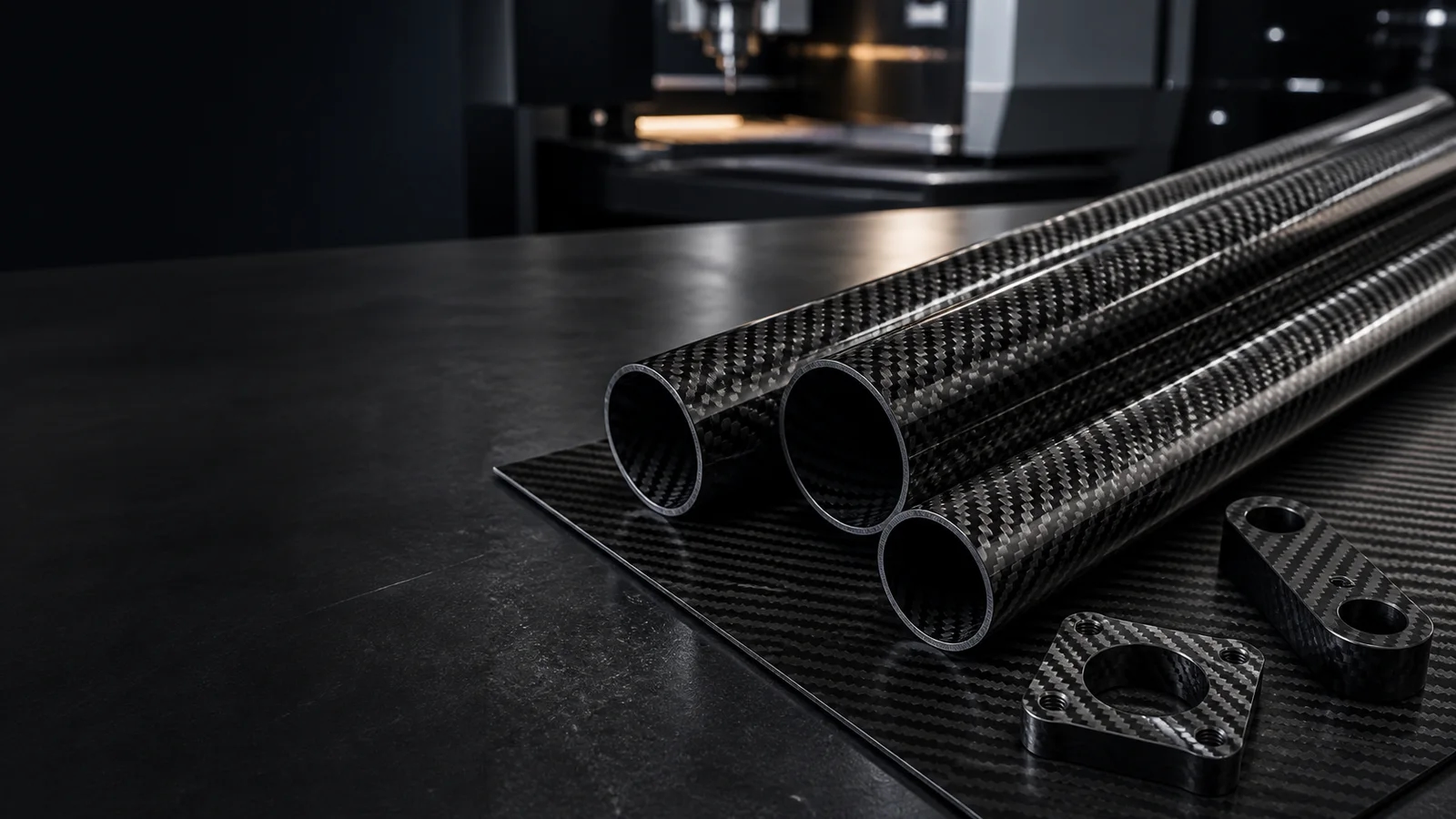
A useful requirement identifies the geometry first, then adds reinforcement, surface, processing, and application context without treating every term as a material grade.
Use the Sheet family for flat laminate, panel, blank, or drawing-defined flat-stock requirements.
Use the Tube family for hollow sections defined by OD, ID or wall, length, construction, and interfaces.
Use the Rod family for solid round sections defined primarily by diameter, length, and application.
Use the Profiles family for strip, flat bar, angle, channel, and other defined non-round sections.
Woven laminate and forged appearance describe different sheet construction or visual requirements. Pultrusion is relevant to continuous rods and profiles and typically emphasizes longitudinal reinforcement, while roll-wrapped construction is a relevant tube pathway. Suitability remains application and project dependent.
Material form, construction, dimensions, finish, processing, quantity, inspection, and delivery requirements can influence sourcing scope. This overview explains the decision path; the Sheet Pricing guide owns detailed sheet-RFQ cost-factor intent.
Provide the information available now. Unknown details can remain project dependent and be clarified during review.
These answers define a review path without publishing universal dimensions, performance values, or commercial commitments.
It may refer to product form, construction route, reinforcement architecture, or appearance. Start with the required geometry and application, then define construction and finish needs.
Sheets are flat laminates or blanks, tubes are hollow sections, rods are solid round sections, and profiles are defined non-round sections such as strip, flat bar, angle, or channel.
No. They describe different construction or appearance concepts. Woven and forged requirements commonly arise in sheet discussions, pultrusion is relevant to continuous rods and profiles, and roll wrapping is a tube construction pathway.
No. Grade terminology and mechanical properties require verified material data. This guide focuses on evidence-safe product forms, construction routes, and buyer selection questions.
Product form defines the basic supply path and geometry. Construction, dimensions, finish, processing, quantity, inspection, packing, and destination then shape the project-specific review.
Use the Carbon Fiber Sheet Pricing guide for detailed sheet quotation inputs such as thickness, dimensions, finish, machining, quantity, inspection, and packing.
Share the application, desired geometry, product form, construction or appearance preference, load and interface context, processing needs, quantity, inspection expectations, and destination where known.
Use the family authority for commercial selection, then send the project inputs for review.